Enterprise ERP
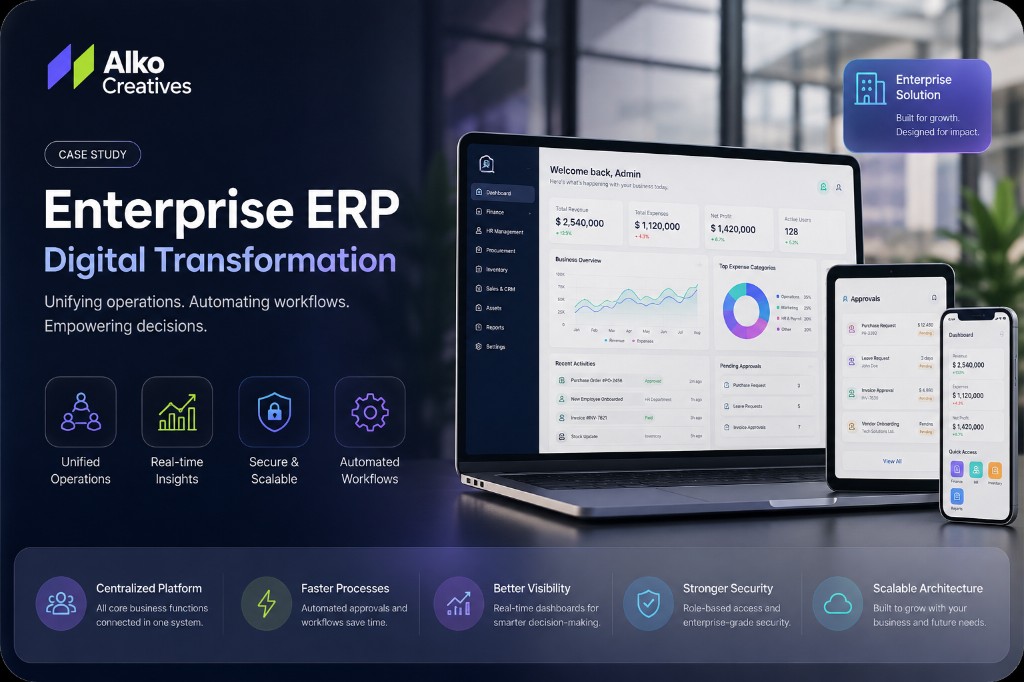
Centralized Platform
All core business functions connected in one system
Faster Processes
Automated approvals and workflows save time
Better Visibility
Real-time dashboards for smarter decision-making
Stronger Security
Role-based access and enterprise-grade security
Scalable Architecture
Built to grow with the business and future needs
Client Overview
A growing enterprise client was managing critical business operations across multiple departments using disconnected applications, spreadsheets, manual processes, and paper-based workflows. As the organization expanded, this fragmented environment made it increasingly difficult to maintain accurate financial information, manage resources efficiently, monitor operational performance, and provide management with reliable real-time information.
Alko Creatives was engaged to design, implement, integrate, and deploy a centralized Enterprise Resource Planning (ERP) platform capable of supporting the client's current operations while providing a scalable foundation for future growth. The client is not named because the engagement is confidential.
The Challenge
The client needed to modernize its internal business operations and replace fragmented processes with a unified enterprise platform. They required more than a software installation. They needed an enterprise-wide digital transformation platform connecting people, processes, financial information, and operational data.
- Finance, procurement, HR, inventory, and operational information were maintained in separate systems
- Many business processes depended heavily on spreadsheets and manual approvals
- Management lacked centralized, real-time visibility into organizational performance
- Duplicate data entry created inconsistencies and increased the possibility of human error
- Procurement and approval processes required significant manual coordination
- Financial reporting required information to be collected from multiple departments
- Employee and administrative information was difficult to manage centrally
- Existing processes were becoming increasingly difficult to scale as the organization grew
- Access to sensitive business information required stronger role-based security and governance
The Alko Creatives Solution
Alko Creatives designed and implemented a centralized Enterprise ERP solution that brought the client's core business functions into a single integrated environment. The solution was designed around the organization's actual operational workflows rather than forcing departments to adapt to disconnected technology.
ERP Modules Implemented
Finance & Accounting
Centralized financial management was implemented to provide better control over accounting operations, expenses, payments, receivables, financial transactions, and management reporting.
Human Resources
Employee information and HR processes were centralized, providing the organization with a structured platform for workforce administration and employee lifecycle management.
Procurement & Purchasing
Procurement workflows were digitized from purchase requests through approvals, purchase orders, supplier management, and financial processing.
Inventory & Asset Management
The organization gained centralized visibility into inventory, organizational assets, stock movements, and related operational information.
Sales & Customer Management
Customer and sales information was consolidated to improve visibility across customer interactions, commercial activities, and business performance.
Workflow & Approval Automation
Multi-level approval workflows were introduced for important business processes, reducing dependence on emails, paper documents, and informal approvals.
Reporting & Management Dashboards
Interactive dashboards and centralized reports were implemented to provide management with greater visibility into financial and operational performance.
Enterprise Architecture
Alko Creatives designed the ERP environment with scalability, security, reliability, and maintainability as core architectural principles. This architecture enabled the ERP platform to become a central business system rather than another isolated application.
- Centralized ERP application architecture
- Enterprise relational database
- Production and testing environments
- Secure HTTPS access
- Role-Based Access Control (RBAC)
- Department-level access permissions
- Automated backup strategy
- Audit logging
- Business workflow automation
- API and integration capabilities
- Centralized reporting
- Infrastructure monitoring
- Disaster recovery considerations
- Scalable architecture for future modules and integrations
Business Process Automation
One of the most important parts of the project was transforming manual processes into structured digital workflows. For example, a traditional procurement process involving emails, spreadsheets, telephone calls, and physical approvals was transformed into a controlled ERP workflow. Every stage could be tracked within the ERP environment. This provided greater accountability while allowing authorized managers to understand the status of business transactions without manually contacting multiple departments.
Purchase Request→ Manager Approval→ Procurement Review→ Purchase Order→ Supplier→ Goods Receipt→ Finance Verification→ Payment→ Reporting
Security and Access Control
Because the ERP platform handles sensitive financial, employee, customer, and operational information, security was incorporated throughout the implementation. Alko Creatives implemented a structured Role-Based Access Control model, allowing employees to access only the functionality and information required for their responsibilities.
- User authentication
- Role-based permissions
- Department-level access restrictions
- Administrative privilege separation
- HTTPS encryption
- Audit trails
- Activity logging
- Controlled administrative access
- Backup and recovery procedures
- Security-focused infrastructure configuration
Data Migration
Existing business information had accumulated across spreadsheets and legacy systems over several years. Customer records, supplier information, employee information, products, financial records, and other required business data were reviewed and migrated into the centralized ERP environment. Validation and reconciliation were performed before production deployment to reduce the risk of inaccurate or incomplete information entering the new system.
Data Assessment→ Cleaning→ Transformation→ Validation→ Import→ Reconciliation
Implementation Approach
Alko Creatives delivered the project through a structured enterprise implementation methodology.
01
Discovery & Requirements Analysis
Our team worked with stakeholders and department representatives to understand existing processes, challenges, reporting requirements, approval structures, and future objectives.
02
Solution Architecture
The ERP architecture, infrastructure, security model, database environment, modules, integrations, and deployment strategy were designed.
03
ERP Configuration & Customization
The platform was configured and customized around the client's organizational structure and business requirements.
04
Integration
Required business systems and services were connected through secure integration mechanisms and APIs.
05
Data Migration
Existing business data was cleaned, transformed, validated, and migrated into the ERP environment.
06
Testing
Functional testing, integration testing, security validation, workflow testing, and User Acceptance Testing (UAT) were conducted before production deployment.
07
Training & Change Management
Users and administrators were trained according to their roles to support successful organizational adoption.
08
Production Deployment
Following successful testing and stakeholder approval, the ERP platform was deployed into the production environment.
09
Support & Continuous Improvement
Post-deployment monitoring, technical support, optimization, and future enhancement planning were incorporated into the engagement.
Business Impact
The ERP implementation transformed the client's operating model from fragmented departmental processes into a more integrated digital environment. The organization gained:
- Centralized business operations through a single enterprise platform
- Improved management visibility through dashboards and consolidated reporting
- Faster internal processes through automated workflows and approvals
- Better financial control through integrated accounting and operational information
- Reduced manual data entry by connecting previously disconnected processes
- Improved data consistency through a centralized source of enterprise information
- Greater accountability through approval histories and audit trails
- Stronger security through structured roles and access controls
- Improved scalability through an architecture capable of supporting additional users, departments, integrations, and business functions
From Disconnected Processes to an Integrated Enterprise
Before
Disconnected processes
- Multiple spreadsheets and applications
- Manual data entry
- Email and paper approvals
- Disconnected departmental information
- Limited management visibility
- Slow reporting and decision-making
After
Centralized Enterprise ERP
- Integrated departments
- Automated business workflows
- Centralized enterprise data
- Real-time dashboards and reporting
- Better operational and management decisions
Technology & Capabilities
Solution: Enterprise Resource Planning (ERP).
ERP Architecture & Implementation
Finance & Accounting
HR Management
Procurement
Inventory Management
Asset Management
Sales & CRM
Workflow Automation
API Integration
Data Migration
Reporting & Analytics
Role-Based Access Control
Backup & Recovery
Infrastructure Security
Monitoring
Alko Creatives' Role
Alko Creatives provided end-to-end ownership of the implementation. Rather than simply deploying ERP software, Alko Creatives delivered an integrated enterprise platform designed around the client's operational requirements and long-term digital transformation strategy.
Business Analysis→ Solution Architecture→ ERP Implementation→ Customization→ Integration→ Data Migration→ Security→ Testing→ Deployment→ Training→ Support
Outcome
The project provided the client with a secure, scalable, and centralized foundation for managing critical enterprise operations. By bringing previously disconnected departments, workflows, and business information into one platform, the organization gained greater operational control, improved visibility, stronger governance, and a technology foundation capable of supporting continued growth.
Alko Creatives — building enterprise systems that connect people, processes, and technology. Start a project or see Software & Digital Products.